Edward de Bono’s Six Thinking Hats is a powerful tool that helps you view situations from different angles through parallel thinking, allowing you to see beyond your habitual thought patterns. This method can be particularly helpful if you often find yourself stuck in negative thinking loops, as it promotes more balanced and comprehensive analysis, aiding in better decision-making and problem-solving.
I first encountered De Bono’s Six Thinking Hats in my Creative Thinking class at university. However, my lecturer, Professor Abdelaziz Berghout, introduced a unique twist by adding a seventh hat—an Islamic perspective that enriches the way we approach creative thinking and problem-solving. This addition was a game changer for me. If you’re navigating a tough decision, dealing with hardships, struggling to understand life’s challenges, or simply want to stretch your creative thinking, this might be the tool for you!
Overview of the “Hats”
Hats have various symbolic meanings in our society. Some are for protection, like construction helmets or sports caps; some denote authority, like the caps worn by pilots, captains, or police officers; while others, like the kufi or yarmulke, signify religious identity. De Bono’s hats are conceptual, each one representing a distinct thinking mode. For example, the “White Hat” represents impartial information-gathering, while the “Green Hat” symbolises the inventive and optimistic mindset.
When you symbolically put on a Thinking Hat, you assume a particular perspective or mindset, allowing your mind to explore new ways of thinking and responding. Embracing different hats gives you the flexibility to examine situations from various angles. In this article, I’ll walk you through each of De Bono’s Thinking Hats with examples, and share insights on the 7th Hat, the Islamic worldview, to help you approach any problem with clarity and wisdom.
Here’s a quick overview of the 7 Thinking Hats:
- White Hat: Mr. Information Gatherer and Mrs. Facts-Checker
- Red Hat: Dr. Emotions and Dr. Gut-Instinct Follower
- Green Hat: Mr. New and Ms. Opportunity
- Yellow Hat: Ms. Optimistic and Sir Idealistic
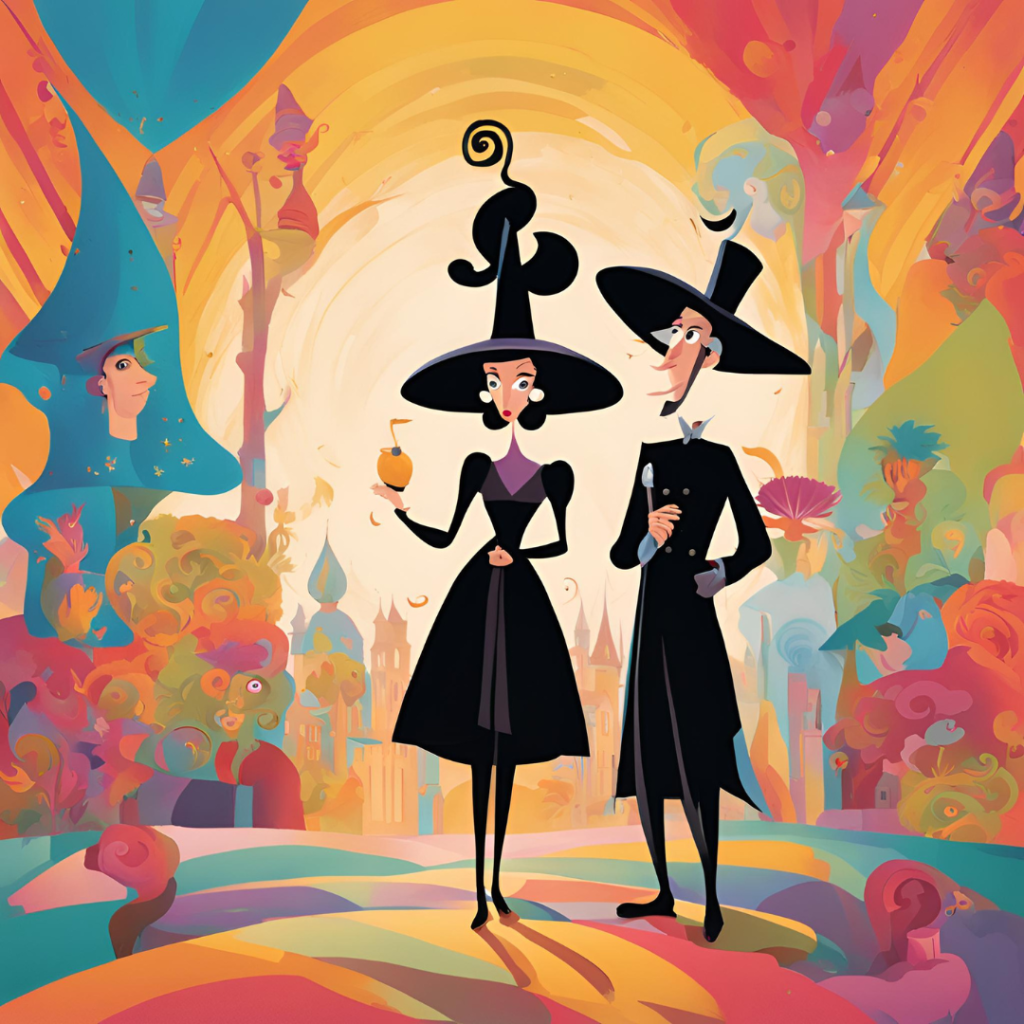
- Black Hat: Lady Wary and Lord Contrary
- Blue Hat: Captain Logic and Sergeant Procedure
- Golden Hat: Sheikh Islamic Worldview and Sheikha Ethics
White Hat: Mr. Information Gatherer and Mrs. Facts-Checker
May was frustrated. She had an argument with her sister, Zahra, about fixing their car window. Zahra had agreed to help with the task, but as May tried to explain the steps, Zahra interrupted her repeatedly, insisting she knew what to do. Eventually, May snapped, raising her voice, and Zahra stormed off, leaving May bewildered and annoyed.
Later, May decided to consult her aunt for advice and admitted her role in the argument. Here, May was wearing her White Hat—seeking clarity, gathering different perspectives, and analysing the situation objectively. With your White Hat on, you focus on gathering all relevant information and verifying its accuracy, whether by listing facts, researching, or asking for others’ insights.

Red Hat: Dr. Emotions and Dr. Gut-Instinct Follower
After her argument with Zahra, May couldn’t ignore the lingering anger and hurt. Her initial reaction was to justify her frustration, yet her intuition nudged her to see past her emotions and explore any underlying issues.
When you wear your Red Hat, you delve into your emotions and listen to your instincts. This can be a powerful tool, as it allows you to recognize feelings that may affect your judgement and can offer valuable insights when combined with other hats.

Green Hat: Mr. New and Ms. Opportunity
May saw this incident as an opportunity to apply lessons from her psychology class on anger management. She discovered that her default anger style was “explosive”—a reactionary approach that might not be the most constructive. Instead, she could have paused to de-escalate her frustration before continuing the conversation.
The Green Hat encourages creativity and brainstorming. It helps you think of new approaches, ideas, or even alternative ways to handle a challenge. For May, the Green Hat opened the door to a fresh, healthier way of managing conflicts.

Yellow Hat: Ms. Optimistic and Sir Idealistic
Despite her hurt feelings, May held onto the hope that she and Zahra could resolve their conflict. She even considered giving Zahra a small gift as a peace offering. May viewed this incident as an uncomfortable yet valuable chance to improve her self-control, and she felt optimistic about their future interactions.
The Yellow Hat is all about optimism, allowing you to focus on the positive aspects and potential benefits. It encourages you to see the brighter side of any situation and hold onto hope for a positive outcome.

Black Hat: Lady Wary and Lord Contrary
Although May was determined to apologise, she also took precautions, avoiding Zahra until both of them had calmed down. She knew there was a chance Zahra might not accept her apology or admit any wrongdoing herself. Still, May focused on taking accountability for her actions and learning from her experience.
The Black Hat is your cautionary ally, prompting you to consider risks and potential pitfalls. It teaches you to think critically about possible downsides or challenges you might face, helping you make well-rounded decisions.
Blue Hat: Captain Logic and Sergeant Procedure
The following day, May gave Zahra a small gift and sincerely apologised. To her relief, Zahra hugged her back and admitted her own struggles. They both agreed that they were learning and growing through life’s challenges.
The Blue Hat synthesises all other hats’ insights, helping you to arrive at a logical and reasoned decision. It’s the hat that guides you in organising thoughts, establishing priorities, and ultimately taking meaningful action.

Golden Hat: Sheikh Islamic Worldview and Sheikha Ethics (The 7th Hat)
Throughout her experience, May relied on her Islamic values to navigate the situation. She reflected on her own shortcomings with humility, acknowledging her need for patience. She valued the bond of sisterhood (ukhuwwah), hoped for reconciliation, and placed her trust in Allah. She took responsibility, practised accountability, and apologized with sincerity, all while ensuring her approach aligned with Islamic principles. This perspective grounded her in faith, empowering her to learn and grow with integrity.
The Golden Hat, or the Islamic worldview, is a guiding light that integrates ethics and faith into problem-solving. It encourages you to view challenges through a spiritual lens, emphasising humility, accountability, and gratitude. This mindset allows you to address difficulties while upholding Islamic values, ultimately helping you become a stronger, more self-aware person.

Conclusion
The 7 Thinking Hats is more than a creative thinking tool—it’s a transformative approach to handling life’s challenges. By wearing each hat, you gain a well-rounded perspective that promotes balanced thinking and more effective problem-solving. And with the Golden Hat, you align this approach with a deep ethical and spiritual grounding, making your actions purposeful and true to Islamic teachings. Next time you’re facing a challenge, try on these hats and experience a new way to think, respond, and grow.
Join Us!
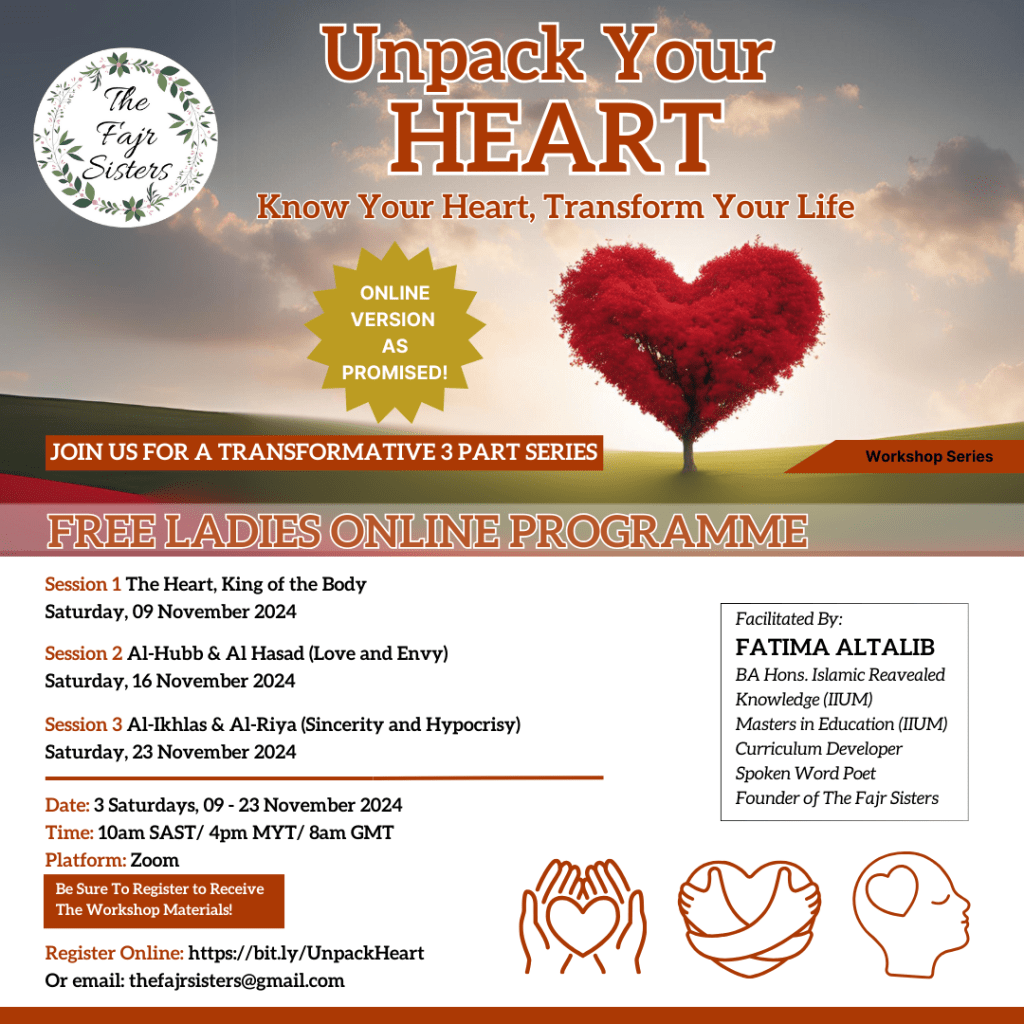
If you’re ready to embark on a journey of self-discovery, healing, and spiritual growth, don’t miss out on our upcoming sessions. Each one is an opportunity to examine your heart, sow the seeds of love, and let go of what no longer serves you.
Secure your spot in our Unpack Your Heart Workshop today, and start transforming your life from the inside out. Sign up here: https://bit.ly/UnpackHeart
It’s time to confront the state of your heart, transform it, and come back stronger from life’s challenges. We can’t wait to see you there!
References
Badi, J. A. (2008). Teaching Creative Thinking Skills and its challenges, strategies and future implications: A narrative of IIUM Experience. Journal of Islam in Asia (E-ISSN 2289-8077), 5(1), 169-188.
Bodur, K . (2018). Writing by putting on Edward De Bono’s Six Thinking Hats: Critical thinking in writing. RumeliDE Dil ve Edebiyat Araştırmaları Dergisi, (13), 138-149. DOI:
10.29000/rumelide.504926
https://www.bitesizelearning.co.uk/resources/six-thinking-hats-technique
 The Fajr Sisters